
Summer is when people finally book the treatment they have been thinking about since January. The jawline, the neck, the crepey bit that shows up in photographs. The plan is usually to get it done now and look good by autumn.
Then the aftercare sheet arrives, and there is a line about sun protection that nobody mentioned in the consultation.
Here is the short version, straight from the manufacturer’s operator manual. Use SPF 30 or higher and protect the treated area from over-exposure to sunlight for at least one month after treatment. Not one month after the course: one month after each session. And excessive tanning of any kind is prohibited for the entire treatment course.
None of that makes a summer booking impossible. It does make it a bigger commitment than the advert implies, and it is much easier to know before you pay a deposit than after.
What the manual actually asks of you
Two instructions, both from the manufacturer’s own document, both easy enough to check.
The first is the SPF one: 30 or higher, and the treated area protected from over-exposure to sunlight, for at least a month after each treatment.
The second is broader. Excessive tanning of any kind is prohibited for the whole treatment course. Not the session, the course. So it starts at your first appointment and does not lift until the last one is behind you.
Put them together and the shape of it is clear. The tanning restriction covers the entire course, and the SPF requirement then adds a month onto the end of it. The sun rules outlast the treatment by about four weeks, minimum.
The two weeks before count as well
Everyone concentrates on aftercare. The manufacturer’s contraindication list has something to say about the fortnight beforehand too: excessively tanned or irritated skin, whether from the sun, a sunbed or a tanning product, within the last two weeks, is a reason not to treat.
That catches more summer plans than people expect. A week somewhere hot, three days before your appointment, is a legitimate reason for a competent practitioner to move you. So is a spray tan booked for the same week. So is a genuinely good fortnight spent in the garden.
The FDA’s general guidance for microneedling devices makes the same point from the other end, listing recent or planned sun exposure among the things that should give you pause. It is not only where your skin has been. It is where it is going next.
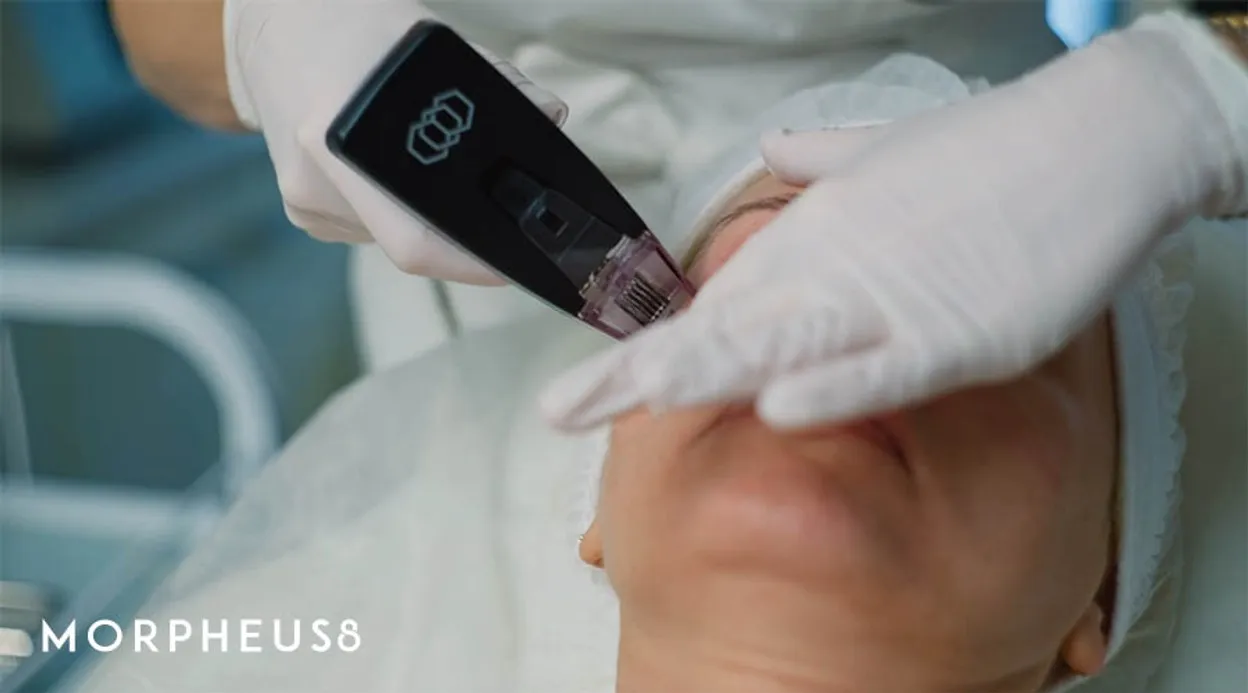
If you are wondering what else sits on that contraindication list, the full version is longer than most clinics volunteer, and several items on it have nothing to do with the sun at all.
Now do the arithmetic
Morpheus8 is not usually sold as a single appointment.
The largest published cohort used 1 to 3 sessions spaced 3 to 6 weeks apart. The acne and acne scarring study used 3 sessions. UK clinic pages, which are marketing rather than research, commonly quote 3 to 6 sessions at 3 to 6 weeks apart.
Take the standard three. At 3 weeks apart, your first and last sessions are 6 weeks apart. At 6 weeks apart, they are 12 weeks apart. Add the month of sun protection the manual asks for after the final session, and you are looking at roughly 10 to 16 weeks from start to finish, with the tanning restriction running across all of it.
That is two and a half to four months. Start in mid-June and the rules are still in force somewhere around late September. Start in August and you are into winter, which, as it happens, is when almost nobody minds.
If a clinic recommends six sessions rather than three, run the same sum again before you agree to it. Planning backwards from a fixed date works the same way, with the aftercare month bolted onto the end.
The downtime you were quoted, and the downtime in the manual
This is where the phrase “minimal downtime” needs dealing with, because it appears on a great many clinic pages and it does not survive contact with the source documents.
Published protocols report 2 to 5 days of downtime. The manufacturer’s manual describes something rather longer: redness lasting not longer than 24 hours, but oedema for 1 to 3 weeks, and crusting from the treated dots that exfoliates naturally over 1 to 3 weeks. An independent review notes visible grid marks persisting 1 to 2 weeks. In the 247-patient cohort, prolonged swelling beyond six weeks occurred in 4.8 percent of patients, and hardened areas beyond twelve weeks in 3.2 percent.
Both ranges are real, and they are measuring slightly different things. The 2 to 5 days figure is what published protocols report. The 1 to 3 weeks is what the manufacturer tells the person holding the handpiece. Consumer content should use the wider one, so that is the one used here.
Then hold that up against a July diary. A fortnight of visible grid marks is a different proposition in the month you are outdoors and photographed than in the month you are wearing a scarf.
Why the rules exist at all
Pigment, mostly.
The manufacturer’s own list of possible adverse events includes pigmentary change in both directions, hyperpigmentation and hypopigmentation. The independent review literature names post-inflammatory hyperpigmentation among the key risks of the procedure. Recently tanned skin is skin with more pigment activity in it, and deliberately heating it is exactly the situation where those problems turn up.
That is also why the manual carries a separate instruction for some patients. For Asian patients and Fitzpatrick skin types IV to V, it says a physician may prescribe a bleaching regimen for 6 to 12 weeks, used 2 to 3 times weekly after healing (typically about 7 days), stopped 48 to 72 hours before the next session. For Fitzpatrick V to VI the manual also caps energy and sets retreatment intervals of every 3 to 4 weeks while energy is being escalated. If any of that applies to you, ask at the consultation, because it lengthens the commitment again.
What the regulator has actually said
One more thing belongs in an article about aftercare, because it changes how seriously to take everything above.
Morpheus8 isn’t FDA approved. It’s 510(k) cleared, which sounds similar and isn’t. Clearance means the paperwork showed the device was similar enough to one already on the market. Nobody at the regulator signed off on it working.
And no Morpheus8 clearance names wrinkles, skin tightening, acne scars, cellulite, stretch marks, body contouring or fat reduction. The cleared wording covers electrocoagulation, haemostasis, and coagulation or contraction of soft tissue. That is the entire indication.
On 15 October 2025 the FDA published a safety communication on radiofrequency microneedling, reporting burns, scarring, fat loss, disfigurement, nerve damage and the need for surgical repair, and stating that radiofrequency microneedling is a medical procedure, not a cosmetic treatment. That sentence is the reason a month of sun protection is not fussiness. It is medical aftercare, for something the regulator has classed as a medical procedure.
There is also no sham-controlled randomised trial of Morpheus8. The one independent systematic review that excluded industry-funded studies rates the radiofrequency microneedling evidence base Level of Evidence 5, the lowest tier there is. So the aftercare commitment is being made against evidence that has never been tested against a convincing placebo. That is not an argument for avoiding the treatment. It is an argument for knowing exactly what you are agreeing to before the summer disappears into it.
If you are booking this summer anyway
Plenty of people will, and the rules are followable. They need planning rather than heroics.
- Keep the two weeks before each session free of sun, sunbeds and tanning products.
- Assume the visible phase could be a fortnight rather than a long weekend, and keep the diary clear accordingly.
- Buy the SPF 30 or higher before the appointment rather than after, and actually use it on the treated area for the full month.
- Hats, shade and sleeves do work that sun cream on its own does not. A wide brim over a treated jawline is earning its keep.
- If you have a holiday booked, give the clinic the dates at the consultation, not afterwards. Sessions can usually be arranged around them. The month afterwards cannot be shortened.

Why autumn and winter quietly win
Nothing in the research says a course works better in one season than another. No study has compared them, and no figure for it exists.
What the darker months give you is a calendar with fewer collisions. Shorter days and more clothing make the sun rules easy to keep almost by accident. There is no week abroad sitting in the middle of the course. Grid marks matter less in a month when you are dressed for weather anyway. And the aftercare month lands somewhere unremarkable rather than across a bank holiday.
That is why a lot of people who research this properly end up starting in September or later. Not because summer is dangerous, but because summer is when these rules are most irritating to follow, and rules that are irritating to follow are the ones that quietly get broken.
Whether this is the right treatment for you at all is a separate question from when to book it, and your age and what you are actually trying to change are worth settling first.
If it is only the timing you are weighing, bring your real diary to the consultation. Holidays, weddings, the work thing you cannot turn up to blotchy. Our practitioners can talk you through a realistic session schedule against those dates, what your skin type means for energy settings and aftercare, and whether the honest answer is simply that this is the wrong month. Book a consultation with us and we will start with the calendar rather than the sales pitch.
At a glance
Booking a Morpheus8 course in summer, weighed honestly
+ Reasons in favour
- The sun rules are written down in the manufacturer's own operator manual, so you can check what a clinic tells you against the source instead of taking it on trust
- SPF 30 or higher and protection of the treated area for at least one month after each session is a specific instruction with a number attached, not vague advice
- Nothing about the treatment itself changes with the season, so moving a course to September costs you nothing clinically and removes most of the scheduling problems
− Reasons for caution
- Three sessions at 3 to 6 weeks apart, plus the month of sun protection after the last one, runs roughly 10 to 16 weeks, and excessive tanning of any kind is off the table for all of it
- The downtime you are quoted and the downtime in the manufacturer's manual are different: 2 to 5 days appears in the published protocol, while the manual describes oedema and crusting resolving over 1 to 3 weeks
- You are organising several months of your summer around a treatment with no sham-controlled randomised trial behind it, and an evidence base the one independent review that excluded industry-funded studies rates Level of Evidence 5
Frequently asked questions
The short version.
01Can I have Morpheus8 if I already have a tan?
Probably not this fortnight. The manufacturer's contraindication list names excessively tanned or irritated skin, whether from the sun, a sunbed or a tanning product, within the last two weeks. A practitioner who reschedules you because you have just come back from holiday is following the manual, not being difficult. The reason is pigment: heating skin that has recently been tanned is the scenario in which post-inflammatory hyperpigmentation tends to show up, and pigmentary change in both directions sits on the manufacturer's own list of possible adverse events.
02How long after a session before I can go on holiday?
The manual asks you to use SPF 30 or higher and protect the treated area from over-exposure to sunlight for at least one month after treatment, so the month does not pause because you have boarded a plane. Separately, published protocols report 2 to 5 days of downtime while the manual describes oedema and crusting resolving over 1 to 3 weeks, and an independent review notes grid marks persisting 1 to 2 weeks. Tell the clinic your dates at the consultation and the sessions can usually be arranged around them.
03Does fake tan count?
For the two weeks before a session, yes: the contraindication names tanning products alongside sun and sunbeds. For the course itself, the manual's wording is that excessive tanning of any kind is prohibited for the entire treatment course, and it does not carve out an exception for bottles and mousses. It also does not spell out what a single application of a wash-off product counts as, so that is a question for your practitioner rather than one this article can answer from the source.
04What is the bleaching regimen the manual mentions?
For Asian patients and Fitzpatrick skin types IV to V, the manufacturer's manual says a physician may prescribe a bleaching regimen for 6 to 12 weeks, used 2 to 3 times weekly once healing has happened (typically about 7 days), and stopped 48 to 72 hours before the next session. The point of it is to reduce the risk of post-inflammatory hyperpigmentation. Note the word physician: it is prescribed and monitored, not bought online, and if it applies to you it stretches the commitment out further again.
05Is a course actually safer in winter?
Nobody knows, and anyone who tells you otherwise is guessing. No study has compared outcomes by season, and no such figure exists in the research. What can be said is narrower and more practical: the aftercare rules are about sun exposure and tanning, and those are simply easier to keep in months with shorter days and more clothing. That is a scheduling argument, not a clinical one.